Aramazd
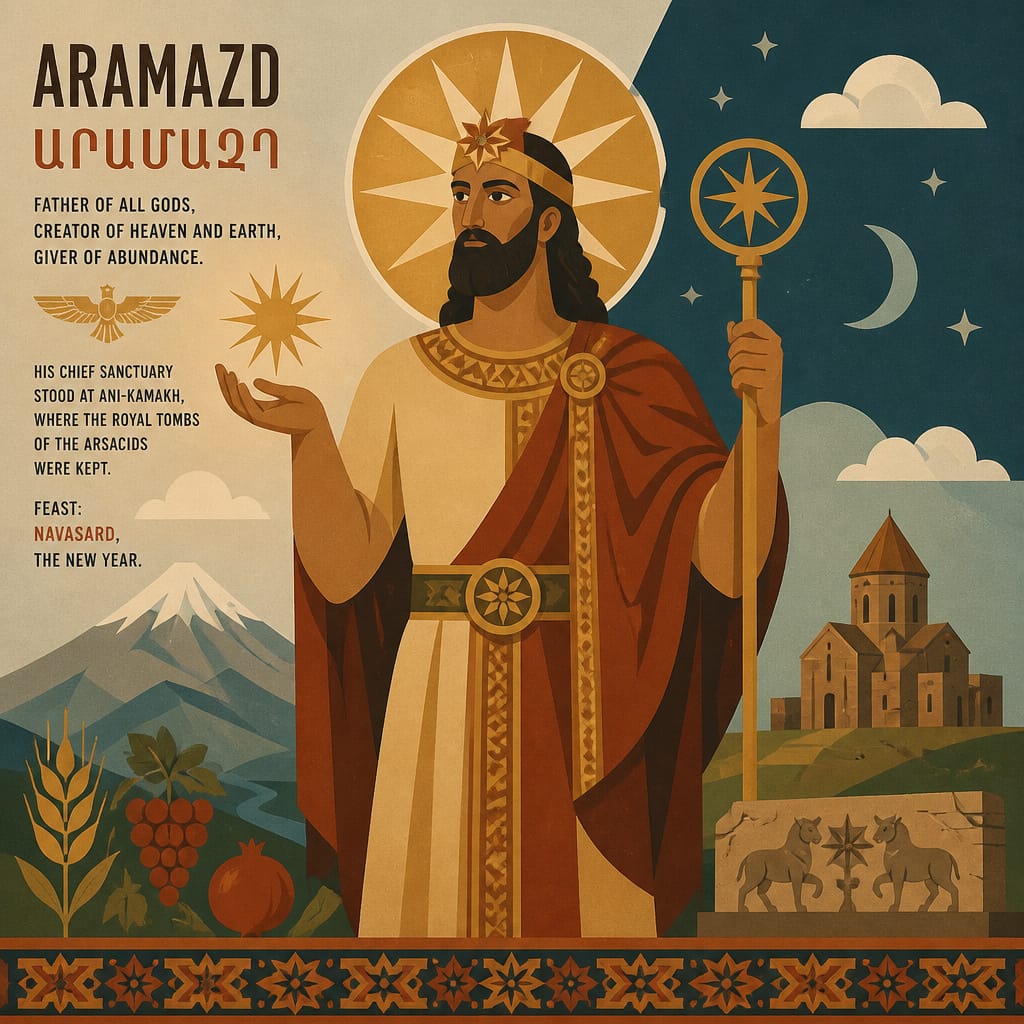
Supreme god of the Armenian pantheon: maker of heaven and earth, giver of abundance, father of Anahit, Mihr, Nane and Tir.
Father of the Gods, Creator of Heaven and Earth
Aramazd stands at the head of the pantheon as the god who made heaven and earth and who fills the land with fatness — the epithet ari, 'valiant', follows his name in the old lists. His cult was centred at Ani-Kamakh on the upper Euphrates, where the Arsacid kings were buried in his precinct, so that the royal dead lay under the protection of the father of the gods.
In the Hellenistic reading he was identified with Zeus, and in the Iranian with Ahura Mazda, but the Armenian god kept a distinctly agrarian face: it is Aramazd who sends the rain, ripens the grain and makes the vine heavy. Later folk memory turned him into the thunder that rolls behind Mount Ararat before the first spring rain.
The New Year, Navasard, opened on the eleventh of August with his great sacrifice at Bagavan, where the whole country gathered for games, horse racing and contests of the gusans, the singer-poets.
Sacred Associations
Associations
Կապեր- Sky, thunder and the ripening rain
- Kingship, oath and lawful order
- Harvest abundance, wheat and the vine
- The ancestral dead of the royal line
Realms
Տիրոյթներ- The high heavens
- Mountain summits, especially Nemrut and Ararat
- The threshing floor and the granary
Sacred Offerings
Ընծաներ- First bread of the harvest, broken and shared
- Red wine poured on stone
- Wheat sheaves and barley
- Frankincense burned at dawn
Taboos
Արգելքներ- Do not swear falsely in his name; the oath on Aramazd was the heaviest an Armenian could take.
- Do not offer to him in anger, or with grain stolen or begrudged.
- Do not petition him for harm against another household.
Sacred Colours
Գոյներ- Deep sky blue
- Gold
- Wheat ochre
Sacred Numbers
Թիւեր- One — the unity of the maker
- Twelve — the round of the year
Establishing a Relationship
- 1
Begin with gratitude rather than request. Aramazd is approached as one approaches a father whose house you already live in: you thank him for the roof before you ask for anything under it.
- 2
Keep an outdoor place if you can — a flat stone, a windowsill open to the sky. His worship was never indoors; the bagin stood under the open heavens.
- 3
Mark Navasard (11 August) each year. Even a loaf and a cup of wine, shared with others, keeps the thread unbroken.
The Offering of the First Bread
At sunrise, best on Navasard or the first day of any harvest
- 1Wash your hands and face in cold water before you begin. Face east, toward the rising sun.
- 2Lay a whole loaf of bread and a cup of red wine on a flat stone or a cloth of blue and gold.
- 3Light incense and say aloud: 'Aramazd ari, father of gods, maker of heaven and earth — I set before you what your rain has made.'
- 4Break the bread with both hands. Set the larger half on the stone; keep the smaller for yourself.
- 5Pour a third of the wine onto the earth, drink a third, and leave a third standing until sundown.
- 6Name one thing you are grateful for and one thing you will steward well in the coming year. Do not ask for more than that.
- 7Leave the bread for birds or animals; never take back what was set out.